
New Skin explores textile waste as a source of new material
lifeIt represents three interconnected meanings:
therebirth of materials,
a new skin for products and an alternativea0proach to circularity.


Background of the research and existing problems

In times of limited resources and growing ecological challenges, sustainable design has become a key focus of innovation.
Each year, 92 million tons of textile waste are generated worldwide. Around 85% is landfilled or incinerated, while only 12–15% is recycled or reused.
In Europe, about 90% of wool (around 200,000 tons per year) unsuitable for textile production is burned as low-value waste.
Many recycled materials never return to the material cycle—especially dyed or mixed fibers such as wool felt and denim.
Problem Statement & Hypothesis
Large amounts of wool felt waste and denim fibers are generated in the textile and furniture industries.
Due to dyes and composite fiber structures, these materials are difficult to recycle and are often incinerated.
Method


Using wet felting combined with denim fibers, discarded wool felt is reactivated at the fiber level.
Through material recomposition
rather than simple assembly.


Material Experiments
During the 2D material testing phase, the first goal was to further determine how variables such as temperature, humidity, alkaline concentration, and pressing time influence the experimental results, in order to achieve denser and higher-quality wet-felt fabrics.
Secondly, the experiments explored the integration between wool felt and denim fibers, aiming to develop textural patterns with potential product applications.


2D Sample Display
Different denim fiber colors and layering methods produced 20 material variations.
Half of the samples present random textures, while the other half display ordered patterns.

These patterns are consistently applied in the subsequent experiments as well as in the final products.
3D Experiments and Results


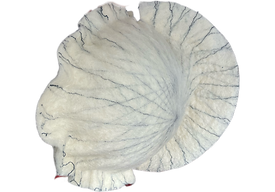


In the 3D experimentation phase, achieving a seamless, one-piece structure without stitching proved highly challenging. Through continuous trials, a more structurally stable and complete form was eventually achieved.
Most importantly, the resulting hollow structure offers more possibilities, such as integrating lighting. When illuminated, the textures become more translucent, with fibers showing different depths and layers. At the same time, each surface of the three-dimensional structure can present different pattern variations, creating a very appealing visual effect.
Product Carriers
I explored several product carriers, each conveying a different meaning.
For products such as cushions and carpets, the material appears as the new surface or “skin” of a product.
For items like chairs, screens, and lighting, the material replaces the original surface of the product, creating a new appearance.
Both interpretations represent important aspects of the “New Skin” concept.
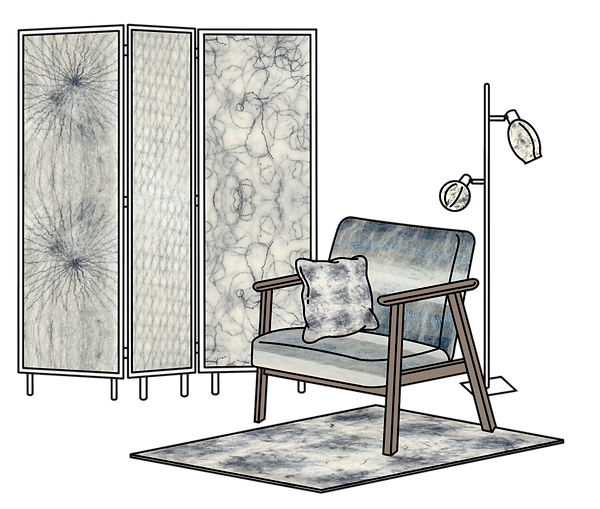


The carriers presented here represent only a small part of the possibilities. In the future, this new composite material could be applied to many more fields.
It is also worth noting that the frameworks of these products are sourced from discarded and second-hand items.

Chair


Lamp

Screen


Future & Outlook
Future development will focus on refining the material and expanding its application across diverse products and environments, allowing the material to continue evolving as a versatile “new skin” for objects and spaces.


