top of page

What is the shape of light in ceramic?
Our design explores this through the translucent, uneven texture of biscuit porcelain—amorphous yet radiant, revealing its luminous identity only when lit.

Inspiration Source


Wedgwood unglazed porcelain candlesticks from the UK.
The light-transmitting properties of ceramics have long been used in artwork. Can this beautiful light-transmitting quality be expressed in new ways in modern design?
Chinese shadow puppetry and light moiré patterns are interesting ways to.


Initial appearance and dynamic concept.
Sheet-like, can be overlapped and expanded. One can change the light angle and brightness by rotating it.
Disadvantage: Too two-dimensional

Initial experiments were conducted using thick paper to simulate ceramic sheets


Morphological considerations

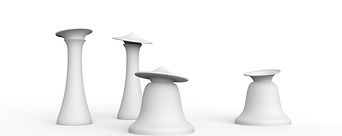


Three-dimensional experiments
The two models are divided into two modules, upper and lower. You can control one module to interact and affect the change of light transmittance of the other module.
Inspiration
Inspired by Zen monks and hermit fishermen, it blends quiet tradition with playful interaction.


All
Process & Texture


Point
Line
Final presentation


Pure porcelain
Texture 1

Texture 2


Texture 3

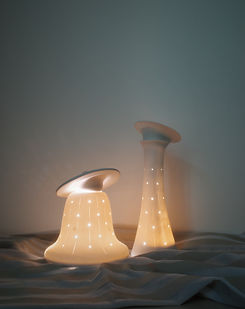


Interactive
pinch the "brim" and turn it to control the brightness of the light.


bottom of page